
The event has concluded: the last keynote is complete, the final exhibit is dismantled, and you are understandably operating on residual energy after managing a demanding series of consecutive days. At this moment, the intrinsic success of the effort is undeniable. You witnessed capacity crowds in key sessions, felt the palpable energy and engagement across the exhibition floor, and observed vital connections forged between attendees, exhibitors, and speakers. Furthermore, initial qualitative feedback confirms the overwhelming positive reception of the experience.
However, before the opportunity arises for a comprehensive debrief, the critical questions start. Key stakeholders—your executive leadership, the often-skeptical finance department, and your major sponsors—will invariably seek confirmation of the same essential objective, articulated through the cold, hard logic of business: “Did this initiative justify the investment? What was the Return on Investment (ROI)?”
For modern event managers, the pressure to prove the intrinsic and monetary value of our work is immense. In today’s data-driven corporate environment, gut feelings and anecdotal feedback about “great vibes” are no longer enough to secure next year’s essential budget. You need hard numbers. You need to speak the universal language of business, and that language is Return on Investment (ROI).
The truly good news? The key to not just defending your budget, but justifying an increase and proving your strategic success, is already at your fingertips. It is embedded within your attendance data, waiting to be unlocked to tell the powerful, financially compelling story of your event.


For decades, the concept of “attendance” was a rudimentary, simple headcount at the door or a tally of registered names. That narrow definition is entirely obsolete. The rich, granular data you can gather with modern event technology from companies like CONEXSYS, offers you an unparalleled, behind-the-scenes look at precisely how attendees interacted with your event.
Think of this comprehensive behavioural data as your new secret weapon, transforming your planning, reporting, and ultimately, your career trajectory. It moves the conversation from simply how many people came to what those people actually did while they were there. This sophisticated data set includes:
- Session Popularity & Capacity Analysis: Exactly how many people checked into each breakout session, workshop, and keynote, allowing you to calculate fill-rate and demand for specific content tracks.
- Detailed Exhibitor and Sponsor Traffic: Which sponsors and exhibitors generated the most foot traffic? More critically, who were the visitors based on their registration profile (e.g., job title, purchasing authority, industry)? This moves the metric from volume to quality.
- Peak Attendee Flow and Heat Mapping: When were the busiest times of day on the main event floor or in specific zones? Where were the bottlenecks or, conversely, the underutilized areas? This is crucial for optimizing future layout and staffing.
- The Attended Journey & Target Prospect Tracking: What exact path did your high-value attendees (like VIPs or top sales prospects) take through the event? Which specific sessions and networking areas did your target demographic attend, offering insights into their current interests and needs?
- Engagement Crossover and Intent Scoring: Which attendees took multiple high-intent actions, such as visiting a sponsor’s booth and also attending their related speaking session? This dual action provides clear evidence of a highly engaged and self-qualified lead, elevating the value proposition for that sponsor.
This is the concrete, irrefutable evidence you need to move confidently from the shaky ground of “I think it went well” to the firm foundation of “I can prove it was a demonstrable success and a valuable business driver.”

Calculating ROI isn’t just a mysterious exercise reserved for the finance team. It is a powerful, essential tool for you to clearly demonstrate your worth and the value of the event portfolio. The fundamental formula is simple:
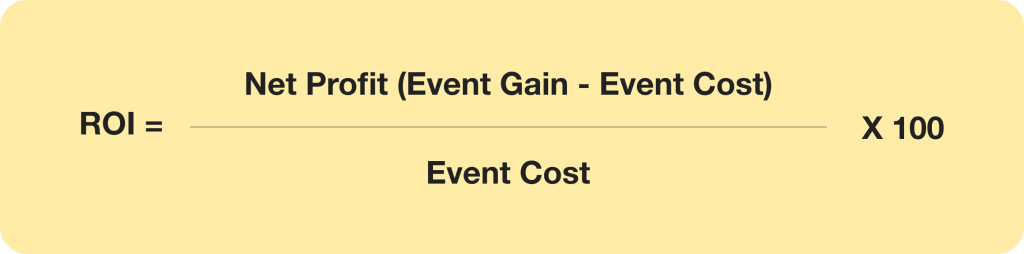
Your “Event Cost” is usually straightforward to track (venue, suppliers, speakers, marketing, technology, staffing, etc.). The “Event Gain” is where the magic of granular attendance data comes into play, allowing you to quantify intangible benefits and connect event activity directly to revenue. Here is how to use it:
1. Make Your Sponsors Your Biggest Fans and Partners
Sponsor retention is often the largest single factor in your event’s financial health. Stop settling for sending a generic “thank you” email and a photo gallery. Instead, send them a bespoke, post-event report packed with quantifiable value that focuses on the quality and intent of interactions, not just sheer quantity.
- The Data: Event registration companies like CONEXSYS can provide reporting detailing that a Gold Sponsor’s booth had 750 unique lead scans. But the critical insight is that you can also report that 250 of the attendees who visited their booth also attended their sponsored, niche breakout session earlier that day.
- The Impact: This data is a game-changer. It proves, without a shadow of a doubt, that the sponsor wasn’t just getting random foot traffic; they were interacting with a highly engaged, interested, and self-qualified audience. This data instantly transforms your vendor relationship into a strategic, data-backed partnership. When sponsors see clear, undeniable evidence of high-intent leads that feed directly into their sales pipeline, renewing for next year’s event becomes an easy, logical business decision.
2. Take the Guesswork Out of Your Agenda Planning
How do you strategically decide which successful speakers to re-book, which content tracks to expand, or which topics to feature in next year’s expensive keynote slots? Stop guessing based on a few comment cards and start using objective data.
- The Data: Session tracking reveals that your high-level “Advanced Cybersecurity: Defensive Strategies” workshop was filled to 120% capacity (standing room only, with a long waitlist), while the entry-level “Intro to Digital Marketing” session was only 30% full.
- The Impact: This data is a goldmine for your next planning cycle. You can confidently argue and invest more heavily in the demonstrably popular cybersecurity track, securing higher-tier, more expensive speakers, and strategically re-evaluate or eliminate the underperforming content. This practice makes your job easier, significantly reduces planning risk, and ensures you’re building an agenda your core attendees truly desire—which, in turn, is the primary driver of next year’s registration numbers.
3. Connect Your Event Directly to the Sales Pipeline
Your event is not just a costly marketing expense; it is a powerful, concentrated sales and lead-generation tool. Now, you can finally prove its essential role.
- The Data: By securely cross-referencing event attendance data (who checked in where) with your company’s Customer Relationship Management (CRM) system, you can show that 50 high-value, Tier-1 prospects attended the specific product demo session and were subsequently scanned and followed up with by your sales team in the executive networking lounge.
- The Impact: This allows you to draw a direct, measurable line from specific event activities (like attending a demo) to subsequent sales progress (pipeline movement, closed deals). This analysis demonstrates to your entire organization—from the CEO to the front-line sales manager—that the event isn’t just a “nice-to-have” expenditure; it is an essential, high-performing part of the core sales and revenue pipeline.

Armed with this level of sophisticated, quantified data, your budget conversations will fundamentally change. You will no longer be on the defensive, pleading for funds. You will be walking in to present an ironclad, strategic business case for expansion and investment.Imagine the confidence of walking into your next budget review and saying this:
“I am formally requesting a budget of $225,000 for next year’s event, representing a 12% increase. Our comprehensive attendance data from this year shows we generated a proven 185% ROI. We provided our key sponsors with over 5,000 highly qualified, high-intent leads, directly feeding into their sales pipelines. Furthermore, session tracking data shows a massive, unfulfilled demand for advanced-tier technical content.
This requested budget increase will allow us to secure the necessary higher-tier, expert speakers for these popular topics, invest in technology to expand capacity for in-demand sessions, and based on the demonstrable lift in engagement this year, we confidently project this targeted investment will increase overall attendee registration by 15% and boost sponsorship revenue by 20% in the next cycle.”
This is the language of leadership. This is how you elevate your role from being an “event planner” focused on logistics to becoming a strategic driver of measurable business growth and revenue.
You work tirelessly to create incredible, meaningful experiences. It is high time you received the credit, respect, and resources you genuinely deserve. By harnessing the transparent, undeniable power of attendance data, you can finally prove what you’ve known all along: your event is one of the company’s most valuable, indispensable assets.
Ready to make data your most insightful and valuable team member? Contact CONEXSYS today and let’s talk about how our attendance tracking solutions can transform your ability to prove your success and secure the future of your events.